The Truth About Test Optional
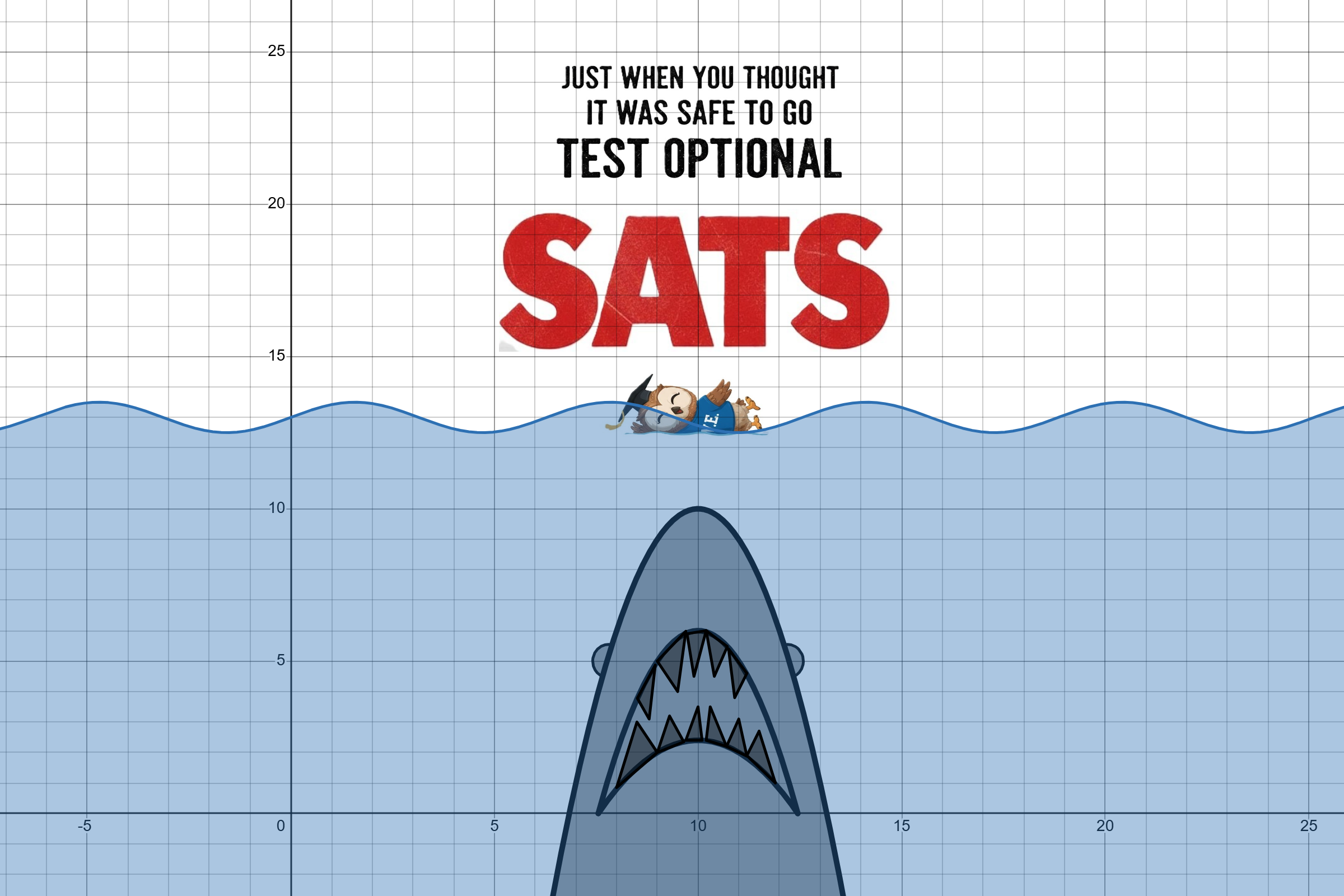
Look out, Witty!
PART I : The Bad News
First, the bad news: Rumors of the demise of the SAT have been greatly exaggerated. We all remember 2020. Covid strikes, hobbling our society. Amid the lockdowns and the protests, the masks and the sanitizer, the soaring political divisiveness and the plummeting toilet paper supply, several noble institutions of higher education joined forces to redress an entire generation’s existential injustice. We will go test optional, they trumpeted, to rectify the wrongs suffered by those students forced to attend class via Zoom from the comfort of their beds, in their pajamas, when they felt like it.
Some colleges even went test-blind! Oh, the beneficence! How can we ever repay you? Well, it turns out we did, and handsomely so, with scads more application fees, lower admission rates, and boosted selectivity metrics.
What the…? But…weren’t the Gen-Zers supposed to benefit…all those digital natives who could never seem to get Zoom to load? (I’m teasing, relax.)
Yes, that’s what happened: Only the colleges benefitted from their ostensible altruism. Hang on tight. Here comes the data train.
PART II: The Big Picture
1. Applications skyrocketed — admit rates fell
A 2023 report from the Common App found:
Colleges that went test‑optional saw a 32% average increase in applications compared to pre‑test optional years.
First‑generation and underrepresented minority applications increased, but admission rates for these groups did not improve proportionally.
TLDR: More students applied, but the same number got in.
2. Students who submitted scores were admitted at higher rates
A 2022 study by the National Association for College Admission Counseling (NACAC) and the National Research Center for College & University Admissions (NRCCUA) found the following:
Students who submitted SAT/ACT scores were admitted at significantly higher rates than non‑submitters.
Submitters also received higher average merit aid.
TLDR: Students who submitted scores got a leg up and cash money.
3. Test‑optional increased institutional selectivity
A 2021 study in Educational Evaluation and Policy Analysis found:
Test‑optional policies led to lower reported admit rates,
higher average GPAs in admitted classes,
and no meaningful change in student academic performance once enrolled.
TLDR: Colleges looked more selective without becoming academically stronger.
4. Test‑optional did not improve equity outcomes
A 2023 analysis by Brookings concluded:
TO policies did not significantly increase enrollment of low‑income or underrepresented students.
The biggest beneficiaries were colleges’ marketing and rankings profiles, not applicants.
TLDR: Seriously?
5. Test‑optional increased colleges’ revenue
A 2022 study from Georgetown Center on Education and the Workforce (CEW) found the following:
Higher application volume → more application fees
Lower admit rates → higher yield → higher tuition revenue
TLDR: Just read–be an example for your kid.
References
Belasco, A., Rosinger, K., & Hearn, J. The Test‑Optional Movement: Implications for Selectivity and Student Success. Educational Evaluation and Policy Analysis, 2021.
Brookings Institution. Test‑Optional Policies and Equity in College Admissions. 2023.
https://www.brookings.edu
Common App. 2022–23 Application Trends: Growth, Equity, and the Test‑Optional Era. 2023.
https://www.commonapp.org
Georgetown CEW. The Financial Impact of Test‑Optional Admissions. 2022.
https://cew.georgetown.edu
National Association for College Admission Counseling (NACAC) & NRCCUA. Defining Access: How Test‑Optional Works. 2022.
https://www.nacacnet.org
Additional Supporting Sources
Inside Higher Ed — “Test‑Optional Boom” (2022): Summarizes institutional incentives and the marketing benefits of TO. https://www.insidehighered.com
Hechinger Report — “Who Really Benefits from Test‑Optional?” (2023):Shows that TO increased applications but not access. https://hechingerreport.org
Harvard Graduate School of Education — “The Test‑Optional Illusion” (2023): Explains why TO does not meaningfully change admissions outcomes for most students. https://www.gse.harvard.edu
PART III: The Case Studies
1. NYU
NYU’s own Common Data Set and institutional research showed the following:
Applications exploded
Pre‑TO (2019): ~85,000 applications
Post‑TO (2021): over 100,000 applications
Post‑TO (2022): over 120,000 applications
This made NYU the most‑applied‑to private university in the U.S.
Admit rate plummeted
2019 admit rate: 16%
2022 admit rate: 12.2%
2023 admit rate: 8% (lowest in school history)
Submitters still had the advantage
NYU reported that students who submitted SAT/ACT scores were admitted at higher rates than non‑submitters.
Source
NYU Office of Institutional Research, Common Data Set 2019–2023.
NYU Admissions Press Releases (2021–2023).
2. University of Chicago
UChicago went test‑optional in 2018 and immediately saw:
Applications surged
2017: ~27,000
2019: over 34,000
Admit rate dropped
2017: 8.7%
2019: 5.9%
Submitters still dominated
UChicago reported that the majority of admitted students still submitted scores, and submitters had higher admit rates.
Source
UChicago Common Data Set 2017–2020.
UChicago “No Barriers” initiative reports.
3. Boston University
BU published one of the clearest TO analyses.
Applications jumped
2020: ~61,000
2021 (first TO cycle): 75,000+
Admit rate fell
2020: 18%
2021: 14%
Submitters had higher admit rates
BU explicitly stated that students who submitted scores were admitted at higher rates than non‑submitters.
Source
Boston University Admissions, “Class of 2025 Profile” and CDS 2020–2022.
4. Georgia Tech
Georgia Tech’s admissions blog (one of the most transparent in the country) published the following data:
Submitters were admitted at higher rates
In multiple cycles, score submitters had a 3–5 percentage point advantage.
TO increased applications but not access
Georgia Tech noted that TO increased volume but did not meaningfully change the demographic composition of the admitted class.
Source
Georgia Tech Admissions Blog, “Test Optional: Year 2 Data” (2022).
5. University of Virginia
UVA’s Common Data Set (CDS) data showed the following:
Submitters had higher admit rates
UVA’s institutional research confirmed that score submitters were admitted at higher rates than non‑submitters.
Applications rose sharply
2020: ~40,000
2022: 50,000+
Source
UVA Common Data Set 2020–2023.
6. Cornell
What follows is from Cornell’s public reporting (2021–2022):
Submitters had higher admit rates
Cornell stated publicly that students who submitted scores were admitted at higher rates than non‑submitters.
TO increased application volume
Cornell saw a 17% increase in applications after going TO.
Source
Cornell Admissions, “Test‑Optional FAQ” (2021–2022).
Cornell CDS 2020–2023.
PART IV: But What About…
…the schools that went test blind? Surely, they must have benefitted all those beleaguered students. I’ll keep this brief. I’m guessing you’re getting the gist.
1. University of California System (UC) — the definitive test‑blind case
The UC system went fully test‑blind starting with the 2021–2022 cycle.
Applications surged
UC received 249,855 applications in 2021 — the highest in its history.
That was a 16% increase over the previous year.
Admit rates fell
UCLA’s admit rate dropped to 10.7% (record low).
Berkeley’s dropped to 14%.
UCSD fell to 34% from 38%.
Demographic shifts were modest
UC reported:
Slight increases in applications from under-represented minority (URM) and first‑gen students
No proportional increase in admits for these groups
Academic performance of admitted students did not improve
UC’s internal analysis found:
No significant change in first‑year GPA
No improvement in retention
No predictive advantage gained by removing tests
Sources
University of California Office of the President (UCOP), Undergraduate Admissions Summary 2021–2023.
UCOP, Standardized Testing Task Force Report (2020).
UC Campus Press Releases (UCLA, UC Berkeley, UCSD).
2. California State University (CSU) — the largest test‑blind system in the U.S.
CSU went fully test‑blind in 2022.
Applications increased
CSU saw a 10%+ increase in freshman applications post‑test‑blind.
Admit rates decreased
Campuses like San Diego State and Cal Poly SLO became more selective, not less.
Equity outcomes did not meaningfully change
CSU’s own analysis showed as much:
No significant increase in enrollment of low‑income or URM students
No improvement in academic preparedness metrics
Sources
California State University Chancellor’s Office, Admissions Data Dashboard (2022–2024).
CSU Board of Trustees, Test‑Blind Policy Report (2022).
PART V: The Good News
Well, we’ll get to the good news in a sec.
Truth is, there are no signs the universities are going to pull a “my bad” and undo the damage they weren’t supposed to have caused in the first place. In fact, after they cashed in their test-optional options, many decided to require SATs and ACTs again.
Since 2022, MIT, Georgetown, Purdue, Georgia Tech, the University of Tennessee system, Auburn, Brown, Dartmouth, Yale, and UT Austin have all reinstated SAT/ACT requirements after internal research showed that test‑optional policies reduced predictive accuracy, complicated equity efforts, and made it harder to identify high‑achieving students from under‑resourced schools.
Now for the good news. Something can be done–but we have to do it, we meaning you, your kid, and the parliament of pedagogues at Wit’s End. If I’ve learned anything in my nearly thirty years of tutoring the SAT and ACT, it’s this: These tests do not test intelligence; they test a student's preparedness to take the tests. So prepare. No institutions–not The College Board, not ACT, Inc., not the universities—can limit how much or how intensely you prepare. So prepare.
These tests are navigable. And we at Wit’s End have exhaustively scouted the terrain. Preparation begins when we hand you the map. So prepare. With our guidance, you will know not only what you’ll encounter but how to overcome it. We at Wit’s End look forward to the moment you decide to take your first step toward college success. See you then.